
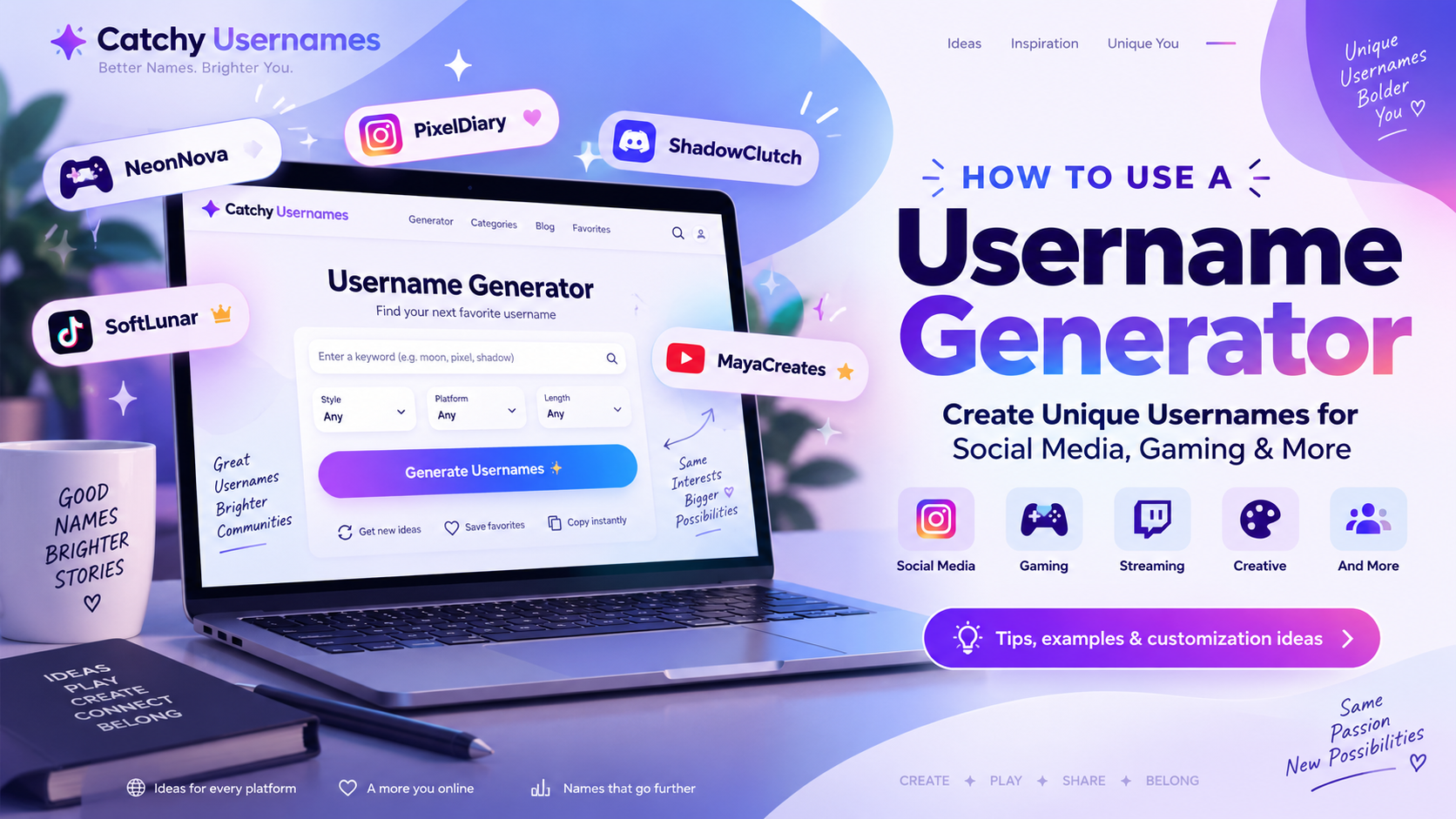
How to Use a Username Generator to Create Unique Usernames for Social Media, Gaming and More
Choosing a good username can look easy until you actually have to create one. You may already know the type of name you want, but finding something that sounds good, looks clean, matches your personality, and is not already taken can quickly become difficult. This problem becomes even more common on popular platforms where millions of people have already registered short and memorable names.
A username is often one of the first things another person notices about your online profile. Before someone reads your bio, watches your content, joins your stream, or plays a game with you, they may already have seen your username. A simple and memorable name can make your profile easier to recognize, while a long combination of random letters and numbers can be harder to remember.
This is where a username generator becomes useful. Instead of trying random combinations for hours, a username generator can give you different ideas based on the information you provide. You can start with your interests, personality, profession, favorite words, gaming style, content niche, or the platform where you want to use the username. You can then compare the generated ideas and customize the ones you like most.
The Catchy Username Generator is designed to make this process more personal. Rather than giving every visitor the same type of random names, the tool lets you provide information such as your category, platform, gender preference, style, important keyword, preferred prefix, favorite number, and preferred suffix before generating username ideas. It also provides a Copy All option so you can quickly save generated results for comparison.
What Is a Username Generator?
A username generator is an online tool that helps people discover possible usernames without manually thinking of every combination themselves. It normally takes one or more pieces of information from the user and combines them in different ways to suggest names that can be used for social media profiles, gaming accounts, streaming channels, forums, creative portfolios, online communities, and many other digital platforms.
The biggest advantage of a username generator is not that it replaces your own creativity. Its real value is that it gives you a starting point. Many people already know the general feeling they want from a username but cannot turn that feeling into an actual name. For example, someone may know that they want a dark gaming name, a soft Instagram handle, or a professional creator name, but they may not know which words to combine. A generator can provide combinations that make the next step much easier.
A good generator also allows personalization. A completely random username such as User784921 may technically work, but it says very little about the account. A name such as LunarCreator, ShadowClutch, PixelDesigner, or SoftNova already creates a stronger impression because the words have a recognizable theme.
The Catchy Username Generator supports this type of customization by letting users give the tool more context before creating names. The current interface includes fields such as Describe Yourself, Category, Platform, Gender, Styles, Important Keyword, Preferred Prefix, Favorite Number, and Preferred Suffix.
Why Choosing the Right Username Matters
A username is not just a technical requirement for opening an account. Over time, it can become part of your online identity. Friends may use it to mention you, followers may search for it, gaming teammates may remember you by it, and viewers may type it when trying to find your channel again.
A strong username usually feels natural when somebody reads or says it. It does not need to be extremely clever. In many cases, simple combinations work better because they are easier to spell and remember. For example, PixelNova is easier to understand than a complicated name filled with underscores, repeated letters, and random numbers.
Your username can also give people a quick idea about the kind of account they are visiting. A name such as ClutchRaven feels suitable for gaming, while MayaCreates sounds more appropriate for a creator profile. QuietPages might work well for a book-related account, while CodeVoyager can fit someone interested in development or technology.
This does not mean that your username must describe everything you do. In fact, an overly specific name can sometimes become limiting. If someone creates a username based entirely on one game and later stops playing that game, the old name may no longer fit. A slightly broader name can often remain useful for much longer.
How the Catchy Username Generator Works
The tool allows you to build a username around several personal choices instead of relying on one keyword alone. You do not need to complete every field every time. The best approach is usually to start with the information that matters most to you and then add more details if the first results feel too broad.
| Generator Option | What It Helps You Define | Example Input |
|---|---|---|
| Describe Yourself | Your identity, interest, role, or personality | Gamer, Designer, Student |
| Category | The general type of account | Gamers, Creators, Social Media |
| Platform | Where you plan to use the username | Instagram, gaming, forum |
| Gender | Optional preference for certain naming styles | Male, Female, Non-Binary, Others |
| Style | The overall mood of the name | Cute, Fantasy, Cool, Professional |
| Important Keyword | A word you want reflected in the username | Creator, Gamer, Designer |
| Preferred Prefix | A word you want near the beginning | Cyber, Pro, Rage |
| Favorite Number | A meaningful number you may want included | 7, 13, 99 |
| Preferred Suffix | A word you want toward the end | King, Master, Monster |
The current tool provides Cute, Fantasy, Cool, and Professional style choices and examples such as Designer, Developer, Creator, and Gamer for the keyword field. It also uses examples such as Rage, Pro, and Cyber for prefixes and Monster, King, and Master for suffixes.
How to Use the Username Generator Step by Step
Start by Describing Yourself
The first useful step is to think about what the account represents. You do not need to write a complete biography. A short description is enough to give direction to the naming process.
For example, instead of thinking only “I need a username,” decide whether you are creating an account as a gamer, designer, student, photographer, streamer, developer, artist, music fan, fitness creator, or something else. This small decision already removes many names that would not suit the account.
If you are a gamer, you can become even more specific in your own mind. A competitive FPS player may want something sharper and more energetic than someone who mainly plays relaxing simulation games. A fantasy RPG player may prefer words connected with magic, legends, moons, dragons, knights, or ancient worlds.
The same principle applies outside gaming. A photographer may prefer words such as lens, frame, focus, light, capture, or visual. A developer might choose code, stack, byte, logic, build, or dev. A creator may prefer words such as studio, craft, creative, works, media, or maker.
Choose the Right Category
Your category helps define the general purpose of the username. Catchy Usernames currently organizes its wider naming content around social media, gamers, streamers, forums, and creators, which reflects how different online spaces often need different naming styles.
A name that looks good in a competitive game may not necessarily look professional on a design portfolio. VenomStrike might work perfectly for a gamer, but a freelance designer may prefer something like AlexCreative, PixelByMaya, or DesignWithLeo.
Choosing a category does not mean every generated username must follow a strict formula. It simply gives the tool and the user a clearer direction.
Think About the Platform
The platform where you use a username can affect what makes a good name. Instagram and TikTok usernames often benefit from being visually clean and easy to search. Gaming names can be more aggressive, funny, fantasy-based, or competitive. Streaming names should be easy to say because viewers may hear the name spoken during videos or live streams. Forum and community usernames can usually be more casual or anonymous.
Imagine that you hear the name of a streamer during a conversation. If the name is simple enough to remember and spell, you may be able to find that person later. If the name contains several unusual spellings, repeated symbols, and numbers, it becomes much harder.
For that reason, always think beyond how the username looks on the registration screen. Think about how another person will read, pronounce, remember, and search for it.
Select a Style That Matches Your Personality
Style changes the feeling of a username more than many people realize. A single base word can produce very different results depending on the mood surrounding it.
Take the word Nova as an example. A cute version might become PeachNova, a fantasy version might become MysticNova, a cool version could be NeonNova, while a more professional variation might be NovaCreative.
The Catchy Username Generator currently includes style options for Cute, Fantasy, Cool, and Professional names. These choices are useful because they help prevent unrelated suggestions. Someone looking for a clean business-like username probably does not need the same ideas as someone looking for a fantasy gaming name.
When you are unsure which style to choose, think about your profile picture, content, color theme, and the type of people you expect to interact with. Your username does not need to match everything perfectly, but it should not feel completely disconnected from the rest of your profile.
How to Use Keywords to Create Better Username Ideas
The important keyword field can be one of the most powerful parts of a username generator because it lets you give the name a clear subject. Instead of receiving only general ideas, you can introduce a word that has meaning to your account.
Suppose you are a designer. You might enter Designer, but you can also experiment with more specific words such as Pixel, Canvas, Visual, or Studio. A gamer could try Clutch, Rogue, Knight, Aim, or Quest. A travel creator could experiment with Wander, Journey, Nomad, or Explore.
The key is to avoid adding too many different ideas at once. If you combine unrelated themes, the username may become difficult to understand. Start with one strong keyword and build around it. If the result does not feel right, change the keyword rather than adding four more words.
For example, CyberWolf is clear and memorable. CyberGamingWolfMasterOfficial99 contains too many ideas and is much harder to remember.
How Prefixes and Suffixes Improve a Username
Prefixes and suffixes are useful when your main keyword feels too common or when the username you want is already taken. A prefix goes before your main idea, while a suffix appears after it.
If your keyword is Wolf, you could add a prefix and create CyberWolf, SilentWolf, FrostWolf, NeonWolf, or ShadowWolf. If you prefer a suffix, you could create WolfKing, WolfAce, WolfMaster, WolfNova, or WolfKnight.
The Catchy Username Generator includes separate fields for a preferred prefix and suffix, making it easier to control where these words appear.
One useful technique is to keep one part of the name simple and allow only the other part to be creative. ShadowNova works because both words are easy to recognize. If both halves use complicated spellings, the result can become difficult to read.
Should You Add Numbers to a Username?
Numbers can be helpful, especially when the username you want has already been registered. However, there is a big difference between adding one meaningful number and adding a long random sequence.
A username such as NovaWolf7 can still look clean. NovaWolf7392841 is much harder to remember.
The generator includes a Favorite Number field, with examples such as 13, 7, and 99. A favorite number, jersey number, lucky number, or another simple number can create a natural variation without making the username look random.
You should also be careful not to reveal sensitive information. Using a favorite number is very different from placing your full date of birth, phone number, or other private information inside a public username.
Creating Usernames for Different Types of Accounts
Social Media Profiles
For social media, readability is usually very important. A username may appear in comments, search results, tags, mentions, reels, profile links, and direct messages. A clean name is easier for other people to recognize.
Names such as DailyNova, AestheticMilo, PixelDiary, SoftLunar, or UrbanMaya are straightforward because they use familiar words and simple structures.
If you are creating an Instagram or TikTok account around a specific content niche, the username can also provide a small hint about your content. A food creator could use a word connected with taste, kitchen, bites, recipes, or meals. A travel account may use words such as road, explore, passport, journey, or wander.
However, avoid making the name so narrow that you cannot change your content later. If you are not sure that you will always create the same type of content, use a slightly broader identity.
Gaming Accounts
Gaming usernames allow more freedom because they can reflect personality, skill, humor, character style, or favorite game genres. A competitive player may like names such as ClutchVex, RapidNova, or ShadowAim, while a fantasy player may prefer RuneKnight, MysticWolf, or DragonNova.
A funny gamer may intentionally choose something less serious, while a competitive player may prefer a short name that looks clean on scoreboards.
Catchy Usernames already separates gamers as one of its major categories and publishes collections for gaming-related naming ideas. That makes the generator useful as both a starting point and a way to create variations based on the gaming styles you already like.
Streaming Channels
A streaming username should be easy to speak aloud. Imagine a viewer recommending your channel to someone else. A simple name such as NovaPlays or MiloLive is easier to communicate than a complicated spelling that needs to be explained letter by letter.
This is especially important for streamers because a username can become part of spoken branding. Viewers may hear it in intros, collaborations, raids, clips, or recommendations.
Before choosing a streaming username, say it aloud several times. If it sounds awkward or is difficult to pronounce, consider a simpler variation.
Forums and Online Communities
Forum names and Discord-style community identities can be more relaxed. They may reflect a hobby, sense of humor, anonymous persona, or inside joke.
Names such as CoffeeAndCode, QuietPixel, RetroThinker, LateNightReader, or PixelNomad can work because they create personality without needing to act like formal brand names.
If you plan to use the same identity for years, however, it is still worth choosing something you will not quickly outgrow.
Creator and Professional Profiles
Creators and professionals often benefit from names that are flexible enough to become part of a personal brand. MayaCreates, AlexDesigns, LeoStudio, or PixelBySam can all work across multiple platforms.
If your real name is available and suitable, you may also use it directly or combine it with your field. A designer named Daniel might use DanielDesign, while a photographer named Sara could use SaraFrames.
Professional does not mean boring. It simply means the username should still make sense when used on a portfolio, email signature, social profile, or client-facing account.
What Makes a Good Username?
A good username is usually easy to read, easy to remember, easy to spell, and relevant enough to feel intentional. It does not need to describe your entire personality, career, or hobby.
One useful test is to imagine showing the username to someone for five seconds and then hiding it. Could that person remember most of it? If yes, the name is probably simple enough.
Another test is pronunciation. If you had to say the username during a video, would another person know how to spell it? This matters especially for creators, streamers, and people building public profiles.
Length also matters. Shorter is not always better, but unnecessary words usually make a username weaker. ShadowPixel is clearer than TheOfficialRealShadowPixelGamingAccount.
A good username should also feel comfortable enough to keep. Trends can change quickly, so choosing a name based entirely on a temporary joke or trend may cause you to want another username later.
Common Username Mistakes to Avoid
One of the most common mistakes is trying too hard to make a name unique. When a simple username is unavailable, people sometimes add several underscores, repeated letters, or long number strings. This may solve the availability problem but creates another problem: the name becomes difficult to remember.
Another mistake is copying a popular creator or gamer too closely. Inspiration is normal, but your username should still create your own identity. A small variation of someone else’s well-known name can create confusion and may make your account look less original.
Using an extremely specific name can also become a problem. For example, if your username is built entirely around one game and you later move to another game, the old identity may feel outdated. Broader names often give you more room to grow.
Finally, avoid including private or sensitive information. A public username should not reveal your complete birth date, phone number, home address, account information, or anything else that could create unnecessary privacy risks.
How to Improve a Username Generated by the Tool
A generated username does not need to be your final username. Think of each result as raw material.
If the generator gives you ShadowNova, you could keep it exactly as it is, or you could turn it into NovaShadow, ShadowNova7, SilentNova, NovaShade, ShadowNox, or LunarShadow.
Small changes are often better than completely rebuilding the name. Try replacing one word, switching the order, adding one short prefix, or adding a meaningful number.
A useful formula is Prefix + Keyword + Suffix + Optional Number. For example, Cyber + Wolf + Ace + 7 could become CyberWolfAce7. You do not always need all four parts. In many cases, two parts are enough.
Another useful formula is Mood + Object, such as SilentMoon. You can also combine Color + Role, such as CrimsonGamer, or Theme + Name, such as PixelAlex.
Username Generator vs Manual Brainstorming
Some people wonder whether using a generator is better than creating a username manually. In reality, the two methods work best together.
Manual brainstorming gives you full control and can produce highly personal ideas, but it becomes difficult when you feel stuck. A generator is faster and can introduce combinations you may not have considered, but you still need to decide which suggestions actually fit you.
The strongest approach is usually to generate several ideas, save the best ones, and then customize them manually. This combines speed with personality.
For example, you may generate ten names and only like two. Those two can still be valuable because they may lead you toward a completely new idea. The purpose of the tool is not necessarily to make the final decision for you. Its purpose is to make the creative process easier.
How to Check a Username Before You Use It
Before committing to a username, search for it on the platform where you plan to create your account. Availability can change, so a name that looks perfect may already belong to somebody else.
It is also useful to search the name on Google, especially if you want to use it as a long-term creator or brand identity. This can help you see whether the same name is already strongly associated with another person, business, product, or community.
If you plan to use several platforms, check whether similar versions are available across the accounts that matter most to you. Complete consistency is not always possible, but having a recognizable core name can make it easier for people to find you.
You should also read the username aloud and type it manually at least once. These simple checks often reveal problems that are easy to miss when you only look at the name on screen.
How to Get Better Results From the Catchy Username Generator
Better input usually leads to more useful ideas. Instead of entering several unrelated words, decide on one clear direction before generating names.
For a cute style, you might experiment with words such as Peach, Bunny, Honey, Berry, Soft, or Moon. Fantasy users can try Mystic, Rune, Dragon, Knight, Spell, or Lunar. Cool names may use Nova, Cyber, Neon, Shadow, Vortex, or Frost. Professional users can experiment with Studio, Creative, Design, Digital, Works, or Media.
If your first set of results does not feel right, change one field at a time. For example, you could begin with Cyber + Gamer, then try Neon + Gamer, followed by Neon + Player, and finally Neon + Player + 7.
Changing one element helps you understand which word is improving or weakening the result. If you change everything at once, it becomes difficult to know which choice made the difference.
The generator also includes a Copy All option after results are generated, so you can save several ideas and compare them later instead of choosing immediately.
Frequently Asked Questions About Username Generators
What Does a Username Generator Do?
A username generator creates possible username ideas based on information such as keywords, styles, categories, interests, prefixes, suffixes, or numbers. It is mainly designed to make brainstorming faster and provide combinations you may not think of manually.
Is the Catchy Username Generator Only for Gaming?
No. The site currently presents username categories for social media, gamers, streamers, forums, and creators, so the generator can be useful for many different types of online accounts.
Can I Enter My Own Keyword?
Yes. The current generator has an Important Keyword field, allowing you to enter words related to your identity, hobby, profession, content, or preferred naming theme.
Can I Choose the Style of My Username?
Yes. Current style options include Cute, Fantasy, Cool, and Professional. Choosing a style helps create a clearer direction for the type of name you want.
What Should I Do if the Username I Want Is Already Taken?
Try a simple variation before completely abandoning the idea. You can switch the order of the words, change the prefix or suffix, use a related keyword, or add one meaningful number. Avoid adding a long sequence of random characters unless there is no better option.
Should I Use the Same Username on Every Platform?
Using a similar name across your main profiles can make your online identity easier to recognize, but exact consistency is not always possible because usernames may already be taken or platforms may have different naming rules. Keeping the same main word or theme is often enough.
Should I Add Numbers to My Username?
Numbers are fine when they have a purpose or help create an available variation. One short number usually looks cleaner than a long random sequence. Avoid using sensitive personal information.
How Long Should a Username Be?
There is no perfect length for every platform, but a username should generally be short enough to remember and long enough to communicate something useful. Clarity matters more than reaching a specific number of characters.
Can I Edit the Names Created by a Username Generator?
Yes. In fact, editing generated names is one of the best ways to use the tool. You can replace a word, change the order, add a prefix, add a suffix, or use a meaningful number until the name feels more personal.
Can I Copy My Generated Username Ideas?
The current Catchy Username Generator provides a Copy All option in the generated usernames section, making it easier to save multiple ideas before choosing your final name.
Final Thoughts
Finding the right username does not have to be frustrating. The best usernames are usually not the most complicated ones. They are the names that are easy to recognize, fit the account, and feel natural when you read or say them.
A username generator helps make the creative process faster by turning your preferences into possible combinations. Instead of guessing random names, you can start with your category, platform, style, keyword, prefix, suffix, or favorite number and then build from the results.
The Catchy Username Generator is useful because it gives you several ways to shape the type of username you want rather than relying on a single random input. Its current options include category and platform selections, gender choices, Cute, Fantasy, Cool and Professional styles, important keywords, prefixes, numbers, suffixes, a Generate Usernames button and a Copy All feature.
The best way to use the tool is to generate several ideas rather than expecting the first name to be perfect. Save the ones you like, compare them, make small changes, check availability, and choose the option that fits your profile best.
A good username may only be a small piece of your online account, but it can become the name that people recognize every time they see your content, play with you, read your posts, or search for you again.
